Substack Audit for Creators: Improve Branding, Positioning, and Conversions

Substack audits help creators understand why a newsletter isn’t converting visitors into subscribers and what to fix first. I review your homepage, profile, branding, and messaging so your publication feels clearer, more credible, and easier for the right readers to subscribe to.
When you’re building a brand on Substack, think of yourself as a painter. You choose colours that work together, use white space with intention, and create an experience. Every visual choice either pulls a reader in or quietly pushes them away. It’s not just a newsletter — it’s the first impression of your business.
Most creators focus on what they write and overlook what people see. That gap is where subscribers disappear.
When I do a Substack audit, I’m not only looking at messaging or content strategy. I’m looking at the full experience of someone arriving at your publication for the first time — what they see, how it feels, and whether anything gives them a reason to stay long enough to hit subscribe.
Does your Substack feel like you? Or does it feel like a version of you from two years ago, built in a rush and never reviewed?
What Is a Substack Audit?
A Substack brand audit looks at your full branding accross your publication — how you appear on Notes, in newsletters, in emails, and across all of your communication and content. It examines your full visual identity and digs deeper into how you're showing up and how others actually perceive you.
Most people on Substack don’t realise they’re not only building a newsletter. There's potential here to build a real business. That's why creating a clear brand identity matters so much. Your brand can lift your entire publication — attracting the clients and readers you actually want to work with.
If you're building on Substack and want to understand how personal branding connects to your publication strategy, this post is a good place to start: How Personal Brand and Substack Work Together.
When Is It Time for a Substack Audit?
When I work with clients, I see three clear situations where a Substack audit becomes the right next step.
You've just set up a new publication and you're not sure if it resonates. You've built something, you're showing up, but you have no real way of knowing whether what visitors see reflects what you intended.
You're in transition or want to elevate your direction. You've been on Substack a while and you've created content, but now you want to change direction, refine your niche, or rebrand for a new chapter of your work.
Your Substack isn't attracting subscribers or the right clients. This is usually a sign that something in your positioning or brand presentation isn't landing — not that the writing is wrong.

Substack Brand Audit Checklist
Download Here
How to Do a Substack Audit
When I work with clients, I always start with the same areas. Here's where to explore first.
Audit your Profile Page
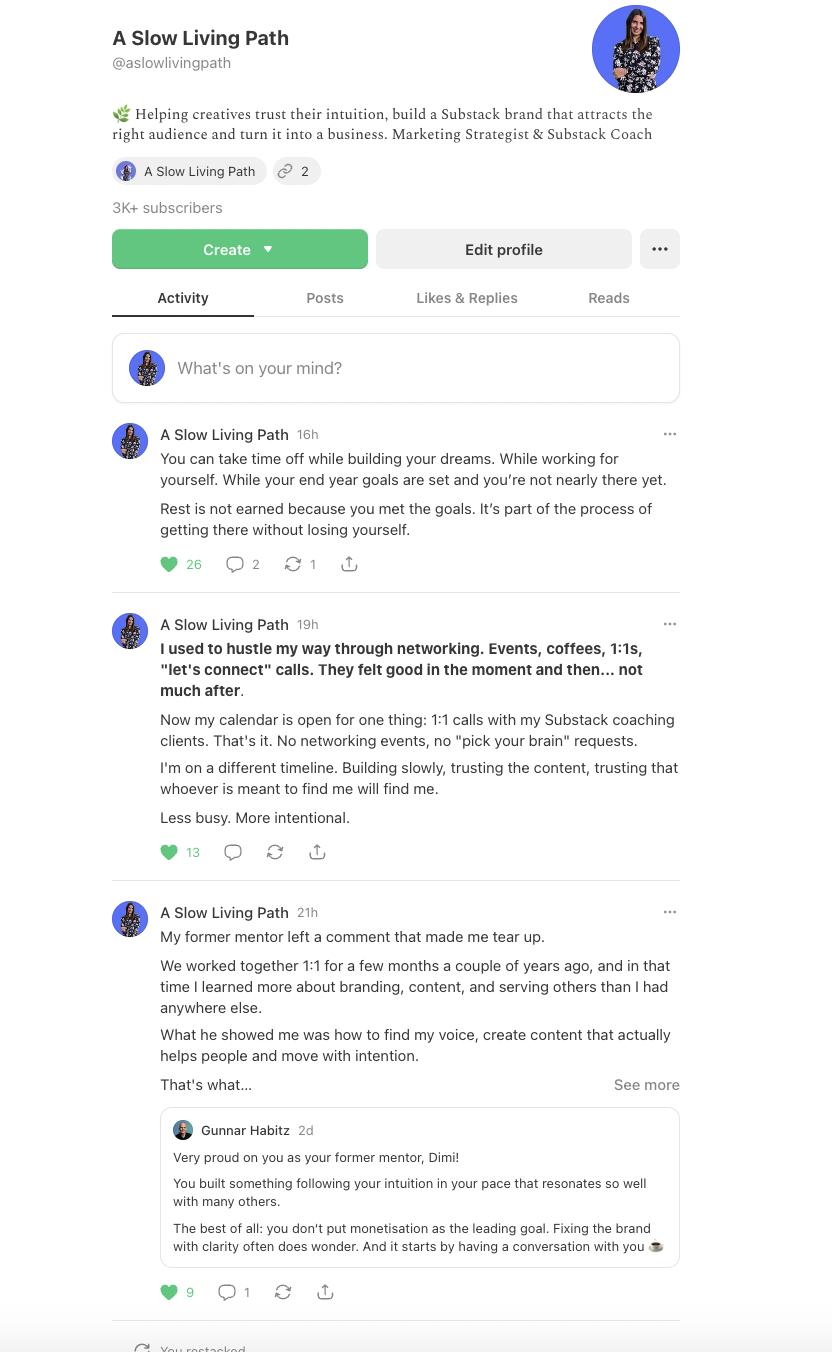
When someone discovers you on Substack, through a restack, a Note, a recommendation — they often click your profile before they ever reach your homepage. That profile page is the first real impression you make, and most people have about ten seconds to decide if they want more.
Ten seconds is generous.
What I see on most profile pages: a mix of restacked content, a few original posts buried underneath, and a bio that doesn't quite explain who this is for. Visitors scroll for a moment, don't feel an immediate pull, and move on.
The issue with restacking is subtle but significant. Restacking is a useful tool for community-building and visibility inside Substack's ecosystem. But when someone visits your profile and the first several pieces of content are other people's work, they have no reason to subscribe to you. They're seeing someone else's voice, someone else's ideas. They haven't experienced yours yet.
Your profile page should answer one quiet question for the visitor: is this person worth following? If they can't find your voice in the first scroll, they'll assume the answer is no.
Audit Your Visual Identity

In my experience working with clients and looking at other creators on Substack, most don't have a visual identity. They have a collection of sporadic decisions. A logo in one colour, images in another, fonts that change from post to post, pictures that don't connect to anything. Nothing wrong with any single piece. Together, they don't tell a coherent story.
Those things matter more than most people realise. Your colours, your fonts, your images — they're not decoration. They're the first signal a visitor gets about whether you're someone worth trusting and following.
Your colours absolutely matter. But the best approach is to choose a few that work together and use them consistently — across your header, your thumbnails, your graphics, everything. Then step back and ask yourself one honest question: does all of this look like it came from the same person?
If the answer is uncertain, that's your starting point.
Bad Images Are Hurting Your Brand

This one is increasingly clear, and I say it gently because so many creators have adopted AI-generated images as a quick, cost-effective solution. Readers are tired of them.
That's not a moral judgement — it's a practical one. People are encountering AI-generated visuals across almost every corner of the internet now, and many have developed an instinctive wariness. An AI image signals speed and efficiency, but it doesn't signal you. And Substack, more than almost any other platform, is built on the promise of a real person writing directly to you.
What works better: a real photo of you, even a simple one. Anything that communicates a person made this.
Your images are part of your brand. They tell visitors whether you're the kind of creator who shows up fully, or the kind who shortcuts the parts no one sees. People can tell the difference, even when they can't name it.
What Your Homepage Reveals in the First Three Seconds
Your Substack homepage is where brand coherence or the lack of it becomes most visible.
When I do a Substack homepage review, I’m asking: does this feel like one person with a clear point of view, or does it feel assembled? Are the thumbnails consistent? Is there a visual thread connecting the posts? Does the header communicate who this is for?
The most common issues I find:
Thumbnails that each look completely different — different fonts, different colours, different styles — so the homepage feels chaotic rather than curated. Even excellent writing looks scattered when it’s framed this way.
No clear statement of who the newsletter is for. A tagline like “thoughts on life and work” is technically accurate and completely uninviting. Visitors don’t know if they belong here.
A homepage layout left on Substack’s default setting rather than chosen intentionally. There are multiple layout options and they behave differently — some create an editorial feel, some feel more personal. The choice matters.
The goal isn’t perfection. It’s coherence. A reader should be able to arrive at your homepage and feel, quickly and quietly, that this place was made for someone like them.
How I Run a Substack Audit
When a client books a Substack audit with me, I work through it in a few clear stages.
Step 1: You share everything
I ask you to share your Substack publication, your profile, your homepage, your thumbnails, and any brand assets or guidelines you have. I go through all of it and document what I find: your colours, your fonts, your imagery, your bio, your homepage layout, how your content is organised, and what a first-time visitor actually experiences when they land on your page.
Step 2: I create a written report
I put it all together in a clear, specific PDF with my findings and a prioritised set of recommendations. Not a list of forty things to fix. The things that are actually costing you subscribers and clients, in the order they need to be addressed.
Step 3: You implement the changes
You take that report and implement it yourself. No calls, no back-and-forth. Just a clear picture of where your Substack brand is right now, what’s working, what isn’t, and exactly what to do next.
Sometimes the audit reveals a few focused fixes. Sometimes it shows that the foundation needs more considered work — a full Substack setup or a visual identity built properly from scratch. Either way, you’ll know which one you’re dealing with, and you won’t be guessing anymore.
Ready for a Clearer, More Converting Substack?
If your newsletter isn’t converting the way you want, the issue is often not your writing — it’s how your brand is presented.
Book a Substack audit and get a clear, prioritised plan to:
Make your homepage feel coherent and intentional
Improve your profile so it pulls the right readers in
Build a visual identity that feels like you
Create a stronger first impression that leads to more subscribers and clients
When you know exactly what to fix, you stop guessing and start moving forward.
Frequently Asked Questions
Who is a Substack audit for?
A Substack audit is for creators, consultants, and small business owners who have a Substack publication but aren’t getting the subscribers or clients they expected. It’s especially useful if you feel your brand looks inconsistent, outdated, or unclear.
What do I get after the audit?
You receive a written PDF report with:
A clear diagnosis of what’s not working visually or strategically
Prioritised recommendations for your homepage, profile, branding, and messaging
A step-by-step plan you can implement yourself
How long does it take to complete?
You can implement most of the key fixes in a few days. The report is designed to be actionable, not overwhelming.
Do we work together on calls?
No. The audit is delivered as a written report. You implement the changes at your own pace, with full clarity on what to do next.
